
On this page
- What did Google announce about the December 2026 core update?
- Why is Google pre-announcing a core update now?
- What changed with the November 2026 core update?
- How should you check if the November update hurt you?
- What counts as a drop worth worrying about?
- Will the December core update affect your Google Business Profile?
- What does “longer and more complex questions” mean for a local business?
- What about personalized results?
- What should you do before the December update starts?
- Final thoughts
- Frequently asked questions
- When does the December 2026 core update start?
- Is the December 2026 core update live now?
- When did the November 2026 core update finish?
- Is a core update a penalty?
- Should I change my website before the December update?
- Will the December core update change my Google Maps ranking?
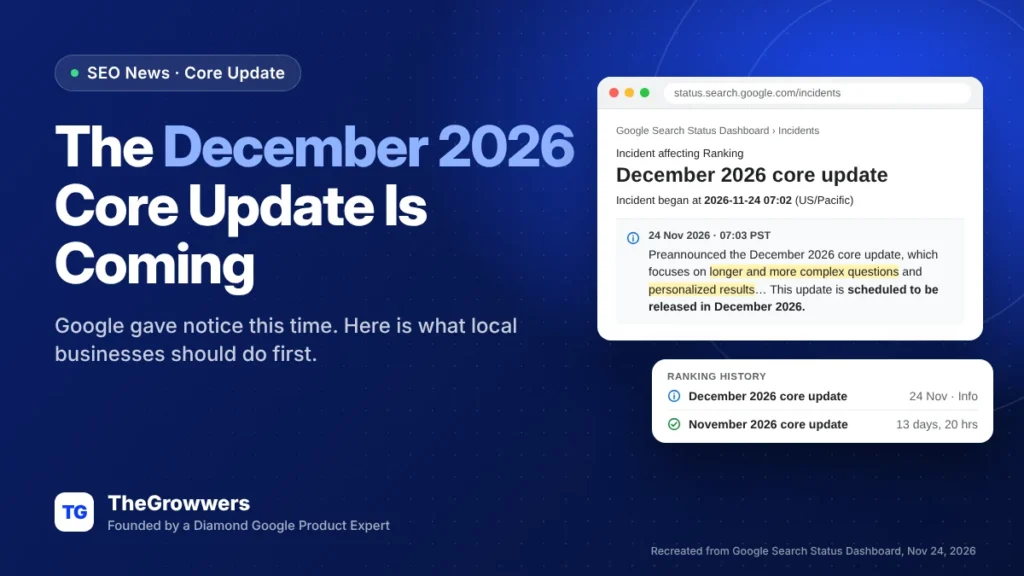
The December 2026 core update is coming, and for once Google told us before it started. On November 24, 2026, Google pre-announced it on the Search Status Dashboard. It isn’t live yet. Google only says it’s “scheduled to be released in December 2026.”
That same morning, the November 2026 core update finished rolling out. So two core updates, back to back, with barely a breather in between.
If you run a local business and your website brings in calls, bookings or walk-ins, this one’s for you. Here’s what Google actually said, what it means for your data, and what we’d do in the next couple of weeks.
Key takeaways
- Google pre-announced the December 2026 core update on November 24, 2026. There is no start date yet.
- It focuses on how Google understands and ranks relevant content, including longer and more complex questions, plus better personalized results.
- The November 2026 core update ran from November 10 to November 24, 2026.
- Google says to wait at least a full week after an update completes before you analyze a drop.
- Don’t make “quick fix” changes. Use the gap to tighten the pages that answer real customer questions.
What did Google announce about the December 2026 core update?
Google posted a notice on its Search Status Dashboard on November 24, 2026 at 07:03 PST. It says the update “focuses on multiple improvements to how our systems understand and rank relevant content (including for longer and more complex questions),” and improves personalized results for people who have personalization turned on. It applies to all locations and languages.
That’s the whole announcement. No date. No list of affected industries.
Barry Schwartz at Search Engine Roundtable asked Google about timing. A Google spokesperson told him there’s no date yet, that Google will announce it “the day it starts rolling out,” and that “It’s not imminent.”
So don’t panic-check your rankings tomorrow morning. Nothing has changed yet.
Why is Google pre-announcing a core update now?
Because the rules changed in the UK. Google published a new page explaining when it gives advance notice of ranking changes, and it says that for changes where UK users may see a significant ranking shift, it gives notice “in accordance with CMA’s fair ranking conduct requirements.” Core updates are listed as an example of a significant ranking change.
This is new behavior. As Search Engine Roundtable points out, Google said for years that it doesn’t pre-announce core updates. Now it does, at least for this one.
Honestly, that’s good news for small businesses. You get a heads-up. Use it.
What changed with the November 2026 core update?
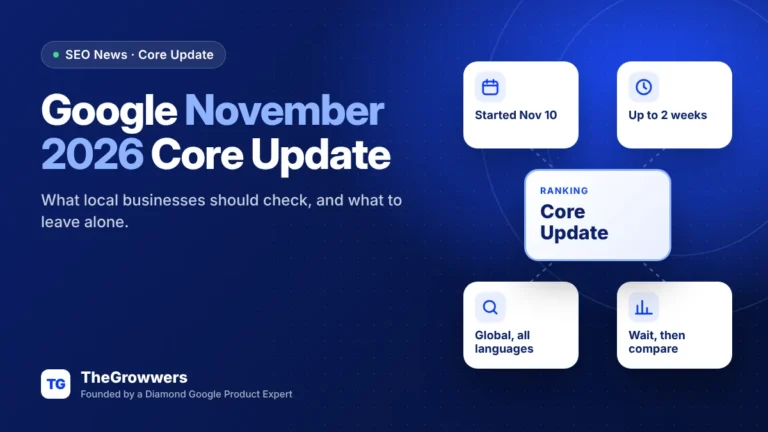
The November 2026 core update started on November 10, 2026 and finished on November 24, 2026. The Search Status Dashboard lists its duration as 13 days, 20 hours. Google called it “a regular update designed to better surface relevant, satisfying content for searchers from all types of sites.”
We covered what to do during that rollout in our November 2026 core update guide. The short version still stands: core updates aren’t penalties, and most sites don’t need to do anything.
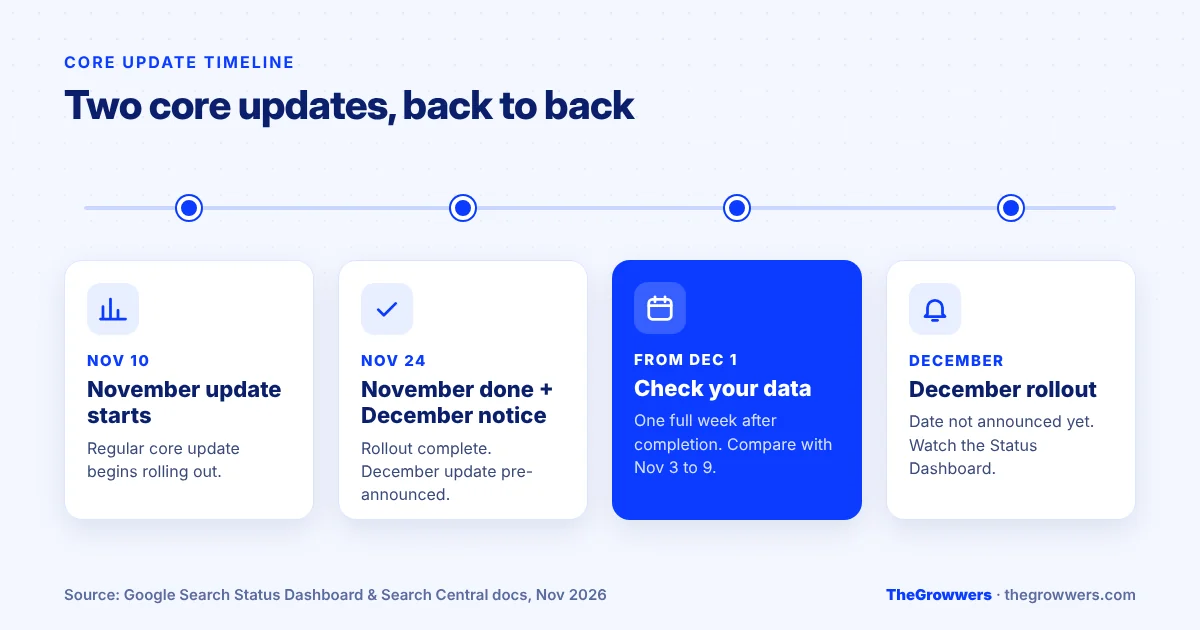
Here’s how the two updates line up:
| Update | Announced | Rollout | What Google said it focuses on |
|---|---|---|---|
| November 2026 core update | Nov 10, 2026 | Nov 10 to Nov 24, 2026 (done) | Better surfacing relevant, satisfying content from all types of sites |
| December 2026 core update | Nov 24, 2026 (pre-announced) | “Scheduled to be released in December 2026,” no date yet | Understanding and ranking relevant content, longer and more complex questions, personalized results |
How should you check if the November update hurt you?
Wait a week, then compare like with like. Google’s core updates documentation recommends waiting at least a full week after an update completes before analyzing Search Console, then comparing that week with a week before the update started.
For November, that means:
- The update finished on November 24, so start looking from December 1 at the earliest.
- Compare the week from December 1 with the week of November 3 to 9 (the week before it started on November 10).
- Look at your top pages and queries, not just total clicks.
And here’s the catch nobody is talking about. If the December update starts early in the month, your “after November” week could overlap with the start of December’s rollout. That makes it hard to tell which update moved what.
So get your November comparison done as soon as that one-week window opens. Screenshot it. Save it. You’ll want a clean baseline before December muddies the water.
What counts as a drop worth worrying about?
It depends on the size. Google’s own examples: a small drop (position 2 to 4) needs no drastic action, and Google actually recommends not changing content that’s already performing well. A large drop (position 4 to 29) deserves a deeper look at your site as a whole.
| What you see | Google’s guidance | What we’d do |
|---|---|---|
| Small dip, e.g. position 2 to 4 | No need for drastic action | Leave the page alone and keep watching |
| Big drop, e.g. position 4 to 29 | Do a deeper assessment | Review the most affected pages against Google’s self-assessment questions |
| Drop in one search type only | Analyze search types separately | Check Web, Images and Video separately in Search Console |
One more thing from Google’s docs: avoid “quick fix” changes, like ripping out a page element because someone online said it’s bad for SEO. Real improvements can take months to show up.
Will the December core update affect your Google Business Profile?
Google hasn’t said. The announcement talks about Search ranking systems in general and doesn’t mention Maps or the local pack. What we do know: Google says local results are mainly based on relevance, distance and prominence, and prominence is partly based on things like how many websites link to your business and your reviews.
Here’s our read. Your Business Profile and your website aren’t separate worlds. If your service pages lose ground in regular results, that can still cost you leads, even if your map ranking holds.
So track both. Your profile’s numbers live in Business Profile performance, and your website clicks from the profile show up properly once you add UTM tracking.
What does “longer and more complex questions” mean for a local business?
It means people are typing (and asking) full questions, not two-word searches. Think “how much does it cost to replace a water heater in a two-story house” instead of “plumber near me.” Google says this update improves how it understands and ranks content for those longer, more complex questions.
Google didn’t publish examples, so don’t read too much into it. But if your service pages are thin (a heading, three bullet points and a phone number), they don’t answer much of anything.
TheGrowwers recommends checking your top three service pages against the questions customers actually ask you on the phone. Price ranges, timelines, what’s included, what’s not, which areas you cover. If the answer lives only in your head, it’s not on the page.
What about personalized results?
Google says the update improves “personalized results for people who have personalization turned on.” It hasn’t explained what that looks like in practice.
The practical takeaway is simple: rankings were never one fixed number for everyone, and they’ll be even less so now. A rank tracker shows you one view. Search Console clicks and impressions, plus your calls and bookings, tell you what’s really happening.
What should you do before the December update starts?
Use the gap to set a baseline and fix what’s genuinely weak. Don’t rebuild your site.
- From December 1, run the November before-and-after comparison in Search Console and save it.
- Note your current Business Profile calls, website clicks and direction requests so you have a “before” number.
- Pick your three most important service pages and make sure each one answers the questions customers really ask.
- Leave pages that are performing well alone. Google says so too.
- Bookmark the Search Status Dashboard. That’s where the real start date will appear.
- When December’s rollout finishes, wait a full week before judging anything.
Final thoughts
Two core updates in a row sounds scary. It doesn’t have to be.
The December 2026 core update gives you something you rarely get from Google: notice. Get your November numbers saved, tidy up the pages that answer real questions, and then let the update roll.
If you’d rather have someone look at your site and profile before December lands, our website SEO and local SEO teams can help. Book a free consultation and we’ll tell you honestly whether anything needs fixing.
Frequently asked questions
When does the December 2026 core update start?
Google hasn’t given a date. The Search Status Dashboard says it’s “scheduled to be released in December 2026.” A Google spokesperson told Search Engine Roundtable that it’s not imminent and that Google will announce it on the day it starts rolling out. Keep an eye on the Search Status Dashboard for the real start date.
Is the December 2026 core update live now?
No. Google pre-announced it on November 24, 2026, but it hasn’t started. The dashboard entry appears as an information notice, which confused some people, but Google confirmed to Search Engine Roundtable several times that the update is not live. Any ranking changes you see right now aren’t from the December update.
When did the November 2026 core update finish?
The November 2026 core update finished on November 24, 2026. It started on November 10, 2026, and the Search Status Dashboard lists the rollout at 13 days, 20 hours. Google recommends waiting at least a full week after completion before you analyze any traffic changes, so December 1 is the earliest sensible date to start.
Is a core update a penalty?
No. Google says core updates are broad changes that don’t target specific sites or pages. If your pages move down, it usually means other pages are now seen as a better match, not that you did something wrong. Google compares it to updating a list of favorite restaurants: the ones that drop aren’t necessarily bad.
Should I change my website before the December update?
Only where there’s a real reason. Google recommends against “quick fix” changes and against changing content that’s already performing well. Improving thin service pages so they answer real customer questions is a sensible move any time. Rewriting your whole site because an update is coming is not.
Will the December core update change my Google Maps ranking?
Google hasn’t said anything about Maps or the local pack in this announcement. Google’s Business Profile help says local results are mainly based on relevance, distance and prominence. Watch your Business Profile performance numbers alongside Search Console, so you’ll notice if either one moves after the rollout.