

On this page
- What is the November 2026 core update?
- When will the November 2026 core update finish?
- Does a core update affect your Google Business Profile?
- What should you do if your rankings dropped?
- Should you change your content during the rollout?
- What does Google consider “helpful” content for a local business?
- What if you still haven’t recovered after a few months?
- Final thoughts
- Frequently asked questions
- When did the November 2026 core update start?
- Is a core update a penalty?
- Does the core update affect Google Maps rankings?
- How long should I wait before changing my website?
- Should I delete thin pages after a core update?
- Can I recover before the next core update?
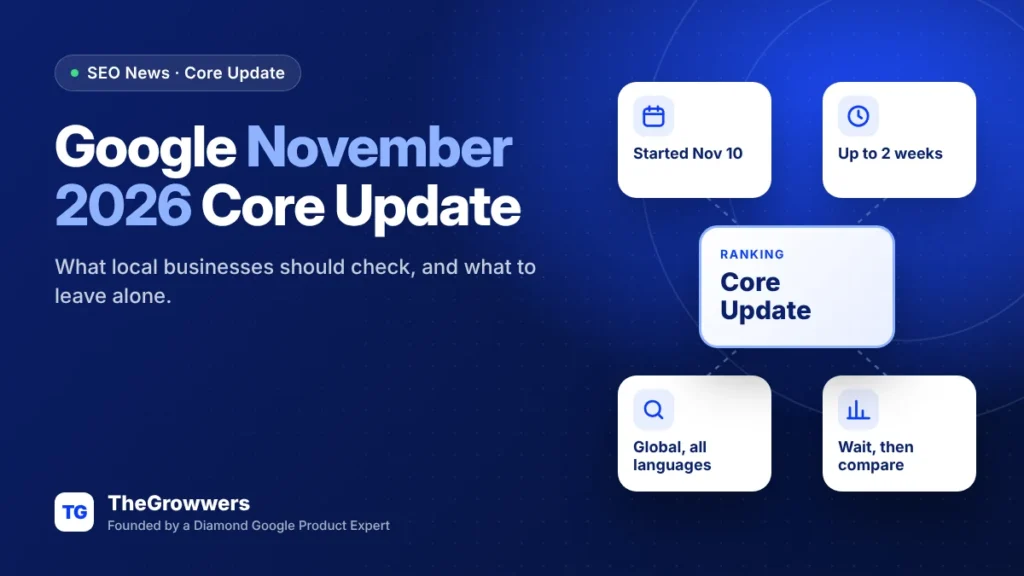
Google started rolling out the November 2026 core update on November 10, 2026, and it may take up to two weeks to finish. If your local business website moves up or down this month, don’t touch anything yet: wait for the rollout to end, wait another full week, then compare the data properly.
This one is for owners and marketers who check Search Console every morning. Maybe you saw a dip on Tuesday afternoon. Maybe a competitor jumped above you for “emergency plumber near me”.
Here’s the honest version: a core update is not a penalty. It’s Google re-sorting results. Our read? The worst thing a small business can do in week one is start rewriting pages in a panic.
Last updated: November 2026
Key takeaways
- The November 2026 core update began on November 10, 2026 (10:06 a.m. Pacific) and “may take up to 2 weeks to complete,” per Google’s Search Status Dashboard.
- It applies globally and to all languages. Google calls it a regular update to surface relevant, satisfying content.
- Google says most sites don’t need to worry about core updates, and it warns against “quick fix” changes.
- Analyze only after the rollout completes plus at least one full week, comparing against a week before it started.
- Small position drops (like 2 to 4) need no drastic action. Big drops (like 4 to 29) call for a real content review.
What is the November 2026 core update?
The November 2026 core update is a broad change to Google Search ranking systems, released on November 10, 2026. It doesn’t target specific sites or industries. Google announced it on the Search Status Dashboard and said it applies globally, in all languages, and may take up to two weeks to fully roll out.
Google posted the update at 10:07 a.m. Pacific on the Google Search Status Dashboard. Search Engine Roundtable reported that Google described it as a regular update meant to surface relevant, satisfying content “from all types of sites.”
It’s the third announced core update of 2026, after the March and May updates, according to the same report.
| Detail | November 2026 core update |
|---|---|
| Start | November 10, 2026, around 10:06 a.m. PT (1:07 p.m. ET) |
| Expected length | Up to 2 weeks |
| Scope | Global, all languages |
| Type | Broad core update (not a spam or manual action) |
| Status (Nov 12) | Still rolling out, no completion posted yet |
Takeaway: put a note in your calendar for the day Google marks it complete, plus seven days. That’s your real analysis date.
When will the November 2026 core update finish?
Google says the rollout may take up to two weeks from November 10, so expect it to finish around November 24, 2026 at the latest. The only reliable signal is the “completed” note on the Search Status Dashboard. Until then, rankings can keep shifting day to day.
Search Engine Roundtable notes that past core updates have taken about 14 days on average, and that this one “should be done just around Thanksgiving time.” Some have run longer. So don’t treat November 24 as a promise.
And yes, that overlaps with Black Friday prep for a lot of local retailers. Annoying timing. But it’s still not a reason to start ripping pages apart.
Does a core update affect your Google Business Profile?
Google’s announcement is about Google Search ranking. It doesn’t mention Google Maps or Business Profiles. Your website’s organic rankings are what you should watch first. If your Business Profile calls or direction requests change at the same time, check your profile separately before blaming the update.
Plenty of things move local numbers at once. A suspended profile, a changed category, a review spike, a competitor’s new listing. Mixing them all up under “the core update hit us” is how people fix the wrong thing.
Here’s a simple split that keeps it clear:
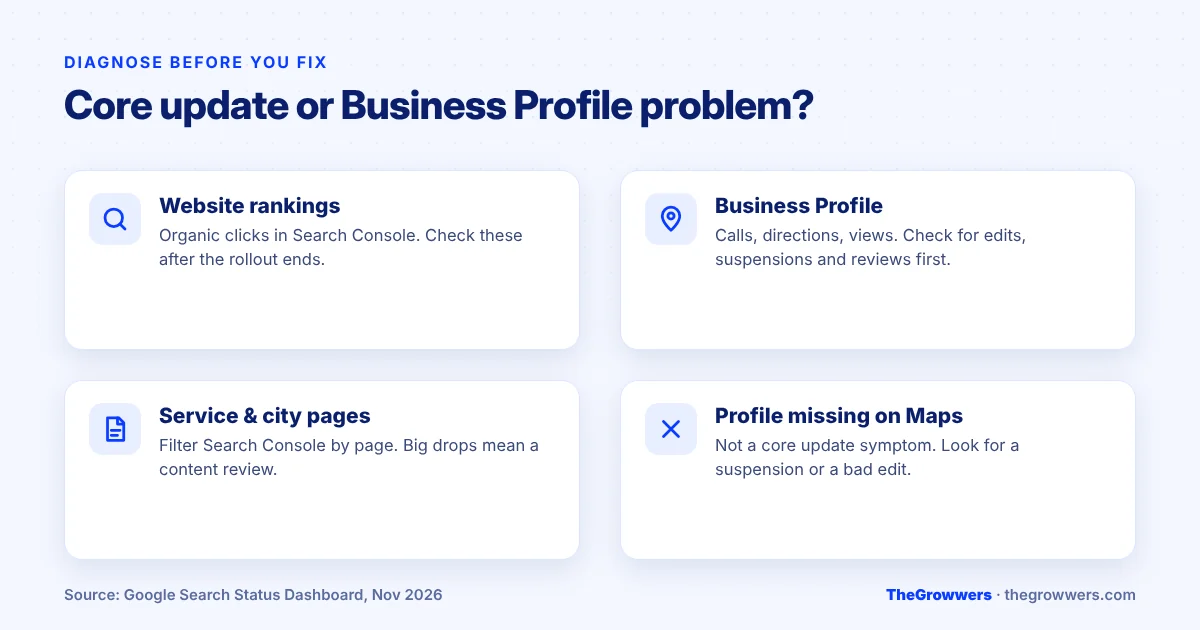
| What dropped | Where to look | Likely related to the core update? |
|---|---|---|
| Organic clicks to your website | Search Console, Performance report | Possibly, check after rollout |
| Calls and direction requests from your profile | Business Profile performance | Check profile issues first |
| Profile missing from Maps | Business Profile status, email notices | Unlikely, look for suspension or edits |
| Location page traffic | Search Console, page filter | Possibly, review page quality |
If your profile itself disappeared, read why some Google Business Profiles get recovered faster before you assume it’s an algorithm thing.
What should you do if your rankings dropped?
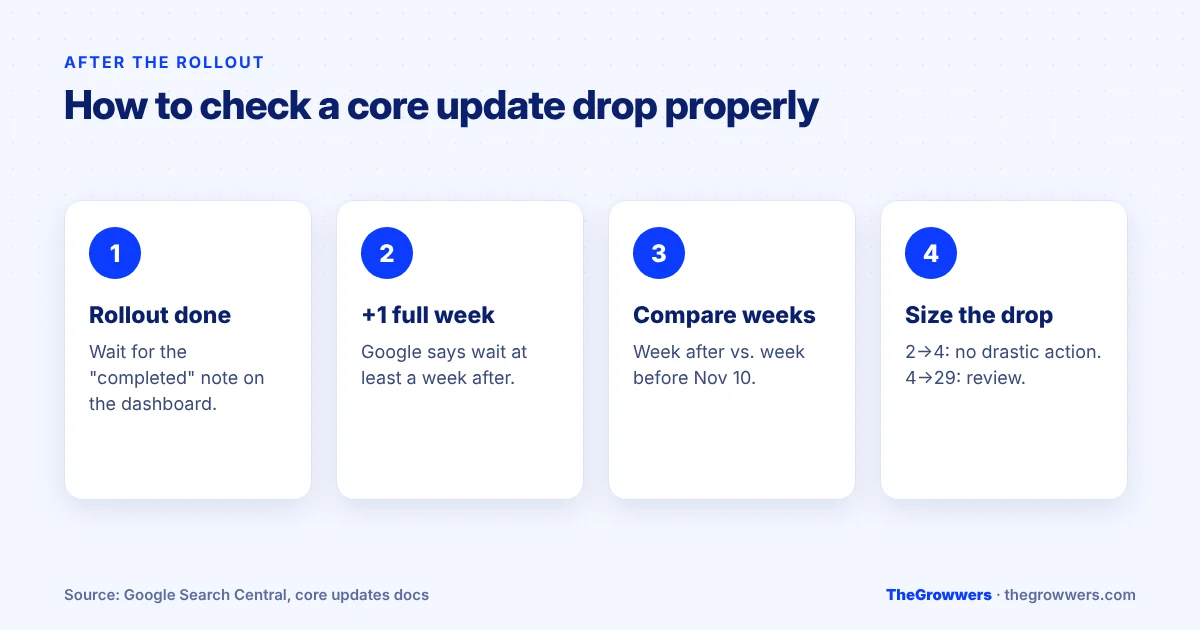
Wait. Google recommends waiting at least a full week after a core update completes, then comparing that week to a week before the rollout started. Look at your top pages and queries. A small slide needs no drastic action. A large, site-wide drop needs an honest review of content quality.
Google lays this out in its core updates documentation. Here’s how we’d apply it to a local service site:
- Confirm the rollout is done. Check the dashboard for the completion note.
- Wait one more full week. Then open Search Console.
- Compare the right dates. One week after completion vs. one week before November 10.
- Sort by pages, then queries. Find which pages lost the most clicks. Is it your homepage, your service pages or your city pages?
- Check the size of the drop. Google’s own example: going from position 2 to 4 doesn’t need drastic action. Going from 4 to 29 does.
- Split search types. Web, Image and Video can move differently, so look at them one at a time.
Takeaway: write the numbers down before you change a single word. Otherwise you’ll never know what worked.
Should you change your content during the rollout?
No. Google specifically warns against “quick fix” changes and says not to change content that’s already performing well. Some improvements can show in a few days, but Google says it could take several months to confirm. Meaningful improvements beat cosmetic edits every single time.
One warning before you start editing later. Google says deleting content should be a last resort. If you’re tempted to delete a whole folder of thin city pages, that’s a sign those pages were built for search engines, not people. That’s a bigger conversation than one update.
TheGrowwers recommends using the waiting time differently: list your weakest pages and ask, honestly, “would a customer find this useful if Google didn’t exist?” Our post on why most location pages fail covers the usual problems.
What does Google consider “helpful” content for a local business?
Google points sites hit by a core update to its helpful, reliable, people-first content self-assessment. For a local business that means pages that show real service details, real coverage areas, clear pricing or process, and who’s behind the work, rather than near-identical pages swapped for each city name.
Google also suggests asking people outside your business to review your site honestly. That’s good advice. Your cousin who doesn’t do SEO will spot the fluffy paragraph you stopped seeing years ago.
Quick self-check for a service page:
- Does it say exactly what you do, and what you don’t?
- Would someone know your service area and how to book after 10 seconds?
- Is there anything on it that only your business could have written?
- Is it the same page as five others with a different city name?
What if you still haven’t recovered after a few months?
Google says that if changes show no effect after a few months, you may have to wait until the next core update. Recovery isn’t guaranteed, and rankings are never fixed. Keep improving the pages that matter most for revenue rather than chasing every position change.
Google also runs smaller core updates that it doesn’t announce. So a site can recover between the big named ones too.
If organic traffic is a big chunk of your leads, that’s when outside help makes sense. Our website SEO and local SEO services start with exactly this kind of review.
Final thoughts
The November 2026 core update is a normal, scheduled reshuffle. It started November 10 and should wrap up within about two weeks.
Sit on your hands until then. Then compare clean date ranges, find the pages that really lost ground, and improve them for people. That’s it. No magic.
Not sure if your drop is the core update or something wrong with your Business Profile? Book a free consultation and we’ll tell you which one it is.
Frequently asked questions
When did the November 2026 core update start?
It started on November 10, 2026, at about 10:06 a.m. Pacific time, according to Google’s Search Status Dashboard. Google said the rollout may take up to two weeks, so it should finish by around November 24. Check the dashboard for the official completion note before you analyze anything.
Is a core update a penalty?
No. A core update is a broad change to how Google ranks results, not a manual action. Google says pages that drop aren’t necessarily bad; other pages may simply be judged more relevant now. If you had a real penalty, you’d see a manual action in Search Console.
Does the core update affect Google Maps rankings?
Google’s announcement covers Google Search and doesn’t mention Maps or Business Profiles. Watch your website’s organic traffic first. If your profile’s calls or views drop at the same time, check the profile for suspensions, edits or review changes before assuming the update caused it.
How long should I wait before changing my website?
Wait until Google marks the rollout complete, then at least one more full week, which is Google’s own recommendation. Then compare a week after completion with a week before November 10. Changing pages mid-rollout makes it impossible to tell what actually helped or hurt.
Should I delete thin pages after a core update?
Google calls deleting content a last resort. Improve pages first: add real service details, clear coverage and useful answers. If you find yourself deleting whole sections, Google says that’s a sign those pages were made for search engines rather than people.
Can I recover before the next core update?
Sometimes. Google says some improvements take effect in a few days, though confirming them can take months. Google also runs smaller, unannounced core updates, so recovery can happen between named updates. But there’s no guarantee, and some sites will need to wait for the next one.